Compliance Infrastructure for AI-Driven Financial Services
Financial institutions cannot prove their AI made the right decision.
That's not a hypothetical risk. It's the gap between how AI is being deployed in regulated workflows today and what regulators require — and it's widening faster than compliance teams can close it.
This post explains how Briefcase AI is built to close it.
The Problem Existing Tools Don't Solve
Existing observability tools — model monitors, LLM tracing platforms, GRC platforms — track what models say. They don't track what knowledge the model used, which version of the rules was active at decision time, or whether the agent applied those rules correctly.
That distinction is what makes compliance hard. Regulators don't ask "what did the model output?" They ask:
- Which version of the rules existed when this decision was made?
- Did the agent correctly apply those rules?
- Can you prove this decision was correct given the rules in effect at the time?
Without version control for AI knowledge, those questions take 2–4 weeks to answer. With Briefcase AI, they take seconds.
Two Systems, One Platform
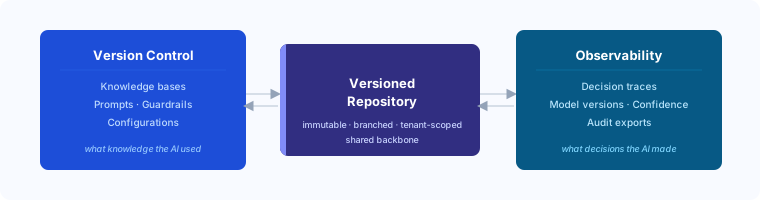
Briefcase AI is version control and observability for regulated AI decisions.
 Briefcase AI Two Systems
Version Control covers everything that informs an AI decision: knowledge bases, prompts, guardrails, and configurations. Every artifact is stored with an immutable commit SHA. Every change is tracked. Every AI agent runs against a specific, pinned version.
Observability covers the decisions themselves: what the AI did, what it referenced, and whether it behaved as expected. Every decision is captured as an immutable trace — inputs, outputs, confidence score, reasoning, and the exact data version active at the moment the decision was made.
Every decision is linked to the specific artifact versions that informed it. That linkage is what makes audit proof instant.
The Versioned Data Backbone
The foundation is a versioned data store shared across both systems.
Think of it as Git for your AI knowledge and telemetry. Sanctions lists, runbooks, policy documents — stored as versioned, structured decision files, not static PDFs. Every commit produces an immutable SHA. Branches are zero-copy. History is permanent.
When an AI agent runs, it pulls knowledge from a specific commit. The Briefcase AI SDK captures that reference automatically. When a regulator asks why a decision was made, one API call returns the full trace — reasoning, data version, confidence score — reconstructed in seconds, not weeks.
The Platform: Observability for Every Decision
The Platform is organized into two layers.
The control plane handles authentication, tenant management, role-based access control, and billing. This is the layer compliance officers interact with — governing who has access to what, under what conditions.
The data plane is the live path for AI telemetry. It ingests decision spans from instrumented agents, writes them to the versioned repository, and makes them queryable for drift detection, compliance reporting, and audit export.
No Migration Required
The Briefcase AI SDK wraps existing AI workflows. No code rewrite. No rip-and-replace. It captures version references and trace data automatically, and integrates with existing OpenTelemetry infrastructure where it's already in place.
See it in action: Complete implementation examples show exactly how to instrument your existing KYC, fraud detection, and credit decisioning workflows with full versioning and audit trails.
Tenant Isolation by Design
 Briefcase AI Tenant Isolation
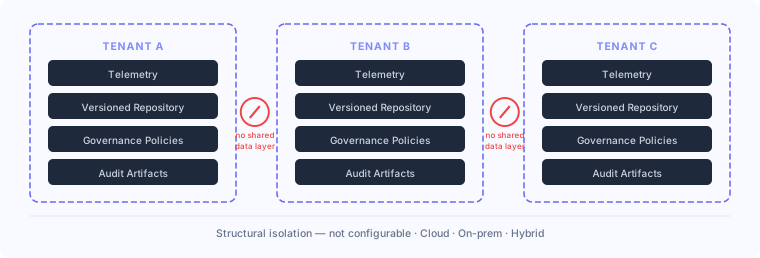
Every tenant operates in a fully isolated data environment. Telemetry, versioned repositories, governance policies, and audit artifacts are scoped to the organization — there is no shared data layer between tenants. This isolation is structural, not configurable. It holds whether the deployment runs in our cloud or inside a customer's own infrastructure.
Your AI decision records never cohabit with another organization's data. Your governance policies reflect your compliance posture exclusively. Your audit artifacts are yours alone.
The Governance Network: Governance Before the Fact
 Briefcase AI Layer Position
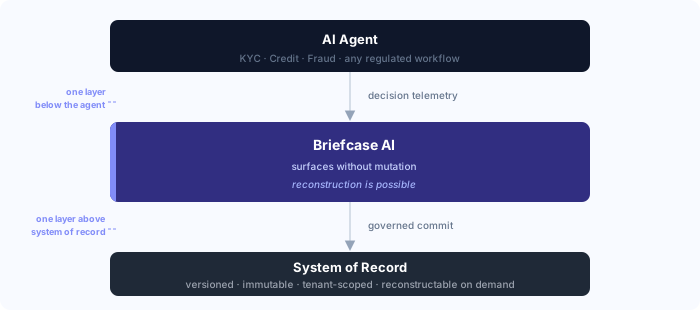
Briefcase AI sits one layer above the system of record and one layer below the agent. It surfaces without mutation — which is precisely what makes reconstruction possible. Most compliance tools audit after the fact; they cannot trace decision provenance in real time because by the time they look, the context is gone. The Governance Network operates at the boundary: every commit is evaluated before it becomes permanent, and the data it surfaces is never altered in the process. The result is a governed record that reflects exactly what happened — not a reconstruction from logs, not a post-hoc approximation.
Deterministic, Not Probabilistic
Governance decisions are made in two stages — both producing deterministic, auditable outputs with a clear trace.
First, hard-coded threshold rules evaluate every incoming commit against non-negotiable conditions: PII detected in telemetry, schema violations, policy flags, security exceptions. If any trigger, the decision is immediate and final. No inference. No override path.
Second, a configurable evaluation engine assesses the commit across a broader set of signals: data quality, schema conformance, lineage integrity, metadata completeness, and temporal consistency against prior commits. The result is a structured, explainable decision — not a probability score, not a black box.
Tenant-Specific Policies. On-Premises Deployable.
Governance policies are not global defaults. Each tenant configures the rules, thresholds, and escalation paths that reflect their specific regulatory environment. A KYC workflow at a bank has different requirements than a credit decisioning workflow at a fintech — and the Governance Network enforces them independently, within each tenant's isolated environment.
For organizations with data residency requirements, the Governance Network deploys on-premises. The evaluation engine runs entirely within your infrastructure boundary. Data never leaves your environment. Supports on-prem, private cloud, and hybrid. No vendor lock-in.
What Happens When an Agent Makes a Decision
 Briefcase AI End-to-End Architecture
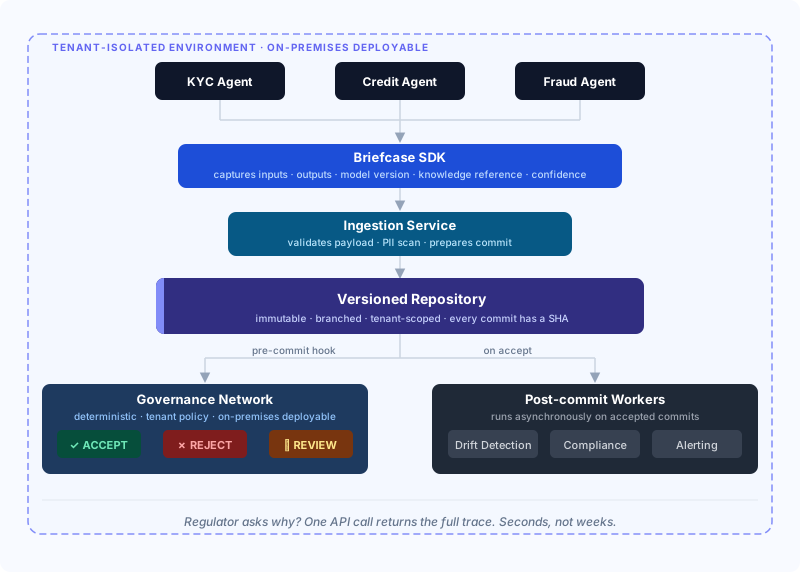
- An AI agent processes a request — a KYC check, a credit application, a fraud score.
- The Briefcase AI SDK captures the decision span: inputs, outputs, confidence score, reasoning, and the exact knowledge version the agent referenced.
- The Briefcase AI SDK batches and flushes telemetry to the Ingestion Service.
- The Ingestion Service validates the payload, scans for PII, and prepares the data for commit.
- The data is committed to the versioned repository — scoped to the tenant and workstream.
- The Governance Network evaluates the commit against the tenant's policy set and returns a deterministic decision: accept, reject, or request human review.
- On acceptance, post-commit workers run drift detection, compliance checks, and alerting where thresholds are crossed.
Regulator asks why? One API call returns the full trace. Seconds, not weeks.
What This Makes Possible
Instant audit proof. Any historical decision is reconstructable on demand — same data version, same inputs, same reasoning. One API call. Complete audit trail. Exam-ready.
Full decision provenance. Every decision is linked to the knowledge it used. Reconstruct exactly which version of the rules was active and whether the agent applied them correctly.
Drift detection. Continuous telemetry means drift is detectable automatically — statistical drift in model outputs and version drift when a model or runbook changes mid-deployment.
Compliance reports without manual compilation. Reports read directly from the versioned data layer at a specific branch reference. What the report says matches what the system did — because they're the same record.
What Briefcase AI Is Not
Briefcase AI is infrastructure, not a model. We don't train your AI, evaluate its fairness, or tell it what to decide. We provide the layer that makes every decision your AI makes traceable, governable, and reconstructable — regardless of which models you use, which vendors you work with, or which regulatory framework applies.
Agentic AI must meet the same supervisory standards as human personnel. Briefcase AI makes that possible without adding headcount.
What's Next
We're working with teams in financial services and regulated enterprise environments. If you're deploying AI into workflows where decisions need to be logged, justified, and reconstructable — we'd like to talk.
Want fewer escalations? See a live trace.
See Briefcase on your stack
Reduce escalations: Catch issues before they hit production with comprehensive observability
Auditability & replay: Complete trace capture for debugging and compliance