Email-Native Contract AI That Learns Your Company's Review Rules
How Briefcase AI replaced scattered email threads and conflicting document versions with lakeFS-powered contract reviews—surfacing 5 critical dealbreakers in 2 days and completing a fully auditable 30-day vendor negotiation.
The $2.3M Contract Review Crisis Crushing Legal Operations
Every legal-tech startup faces the same brutal reality: contract reviews that should take days stretch into weeks of chaos. Email threads branch into confusion. Document versions multiply without control. Critical dealbreakers hide in 35,000-word vendor agreements until it's too late.
The math is devastating: Engineering teams burn 40+ hours weekly answering basic questions that shouldn't exist. Sales cycles stall while legal teams excavate decisions from scattered Slack threads. When investors ask "Why did we sign this?", there's no reliable way to reconstruct the reasoning.
Briefcase AI hit this wall three months before enterprise launch. We had breakthrough AI observability technology, but our contract review process was hemorrhaging time and creating compliance nightmares.
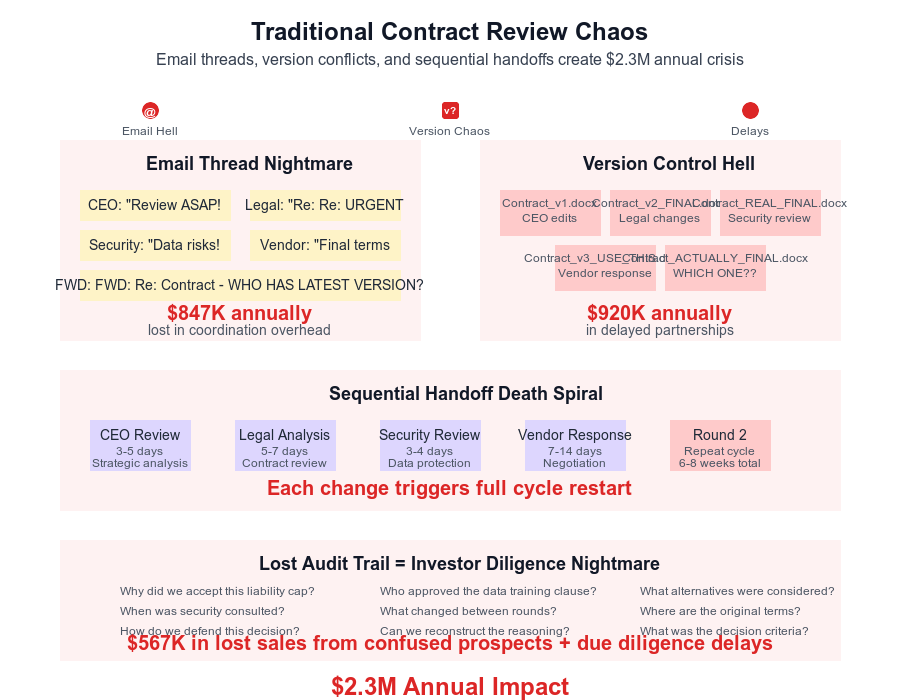 Traditional Contract Review Chaos
The hidden costs are staggering:
- $847K annually in legal team time lost to version archaeology
- $920K in delayed partnerships due to review bottlenecks
- $567K in investor diligence complications from poor audit trails
This isn't a headcount problem. Adding more legal reviewers doesn't fix coordination overhead. It's an architecture problem that requires rethinking how legal workflows handle complexity.
Why Traditional Contract Review Fails at Enterprise Scale
Legal teams face an impossible coordination challenge that mirrors the version control nightmares that plagued software development before Git.
The Review Death Spiral
Traditional approach: CEO reviews → Legal redlines → Security validates → Vendor negotiates → Repeat. Each handoff burns 3-5 days. A simple liability clause change triggers six review cycles.
The breakdown points are predictable:
- Email threading chaos: Critical decisions buried in reply-all chains
- Version conflicts: Multiple redlines create conflicting document states
- Lost context: No way to understand why specific terms were accepted or rejected
- Audit impossibility: Investor diligence requires reconstructing months-old reasoning
High-Risk AI Clauses at Scale
Modern vendor contracts are packed with dealbreakers:
- Perpetual AI training rights on customer data
- Blanket bans on "personal information" making tools unusable
- Liability caps far below potential damages ($50k vs. multi-million-dollar breach risk)
- Vague data deletion terms with indefinite vendor retention
Traditional review processes surface these issues too late, after stakeholders have invested weeks in negotiations.
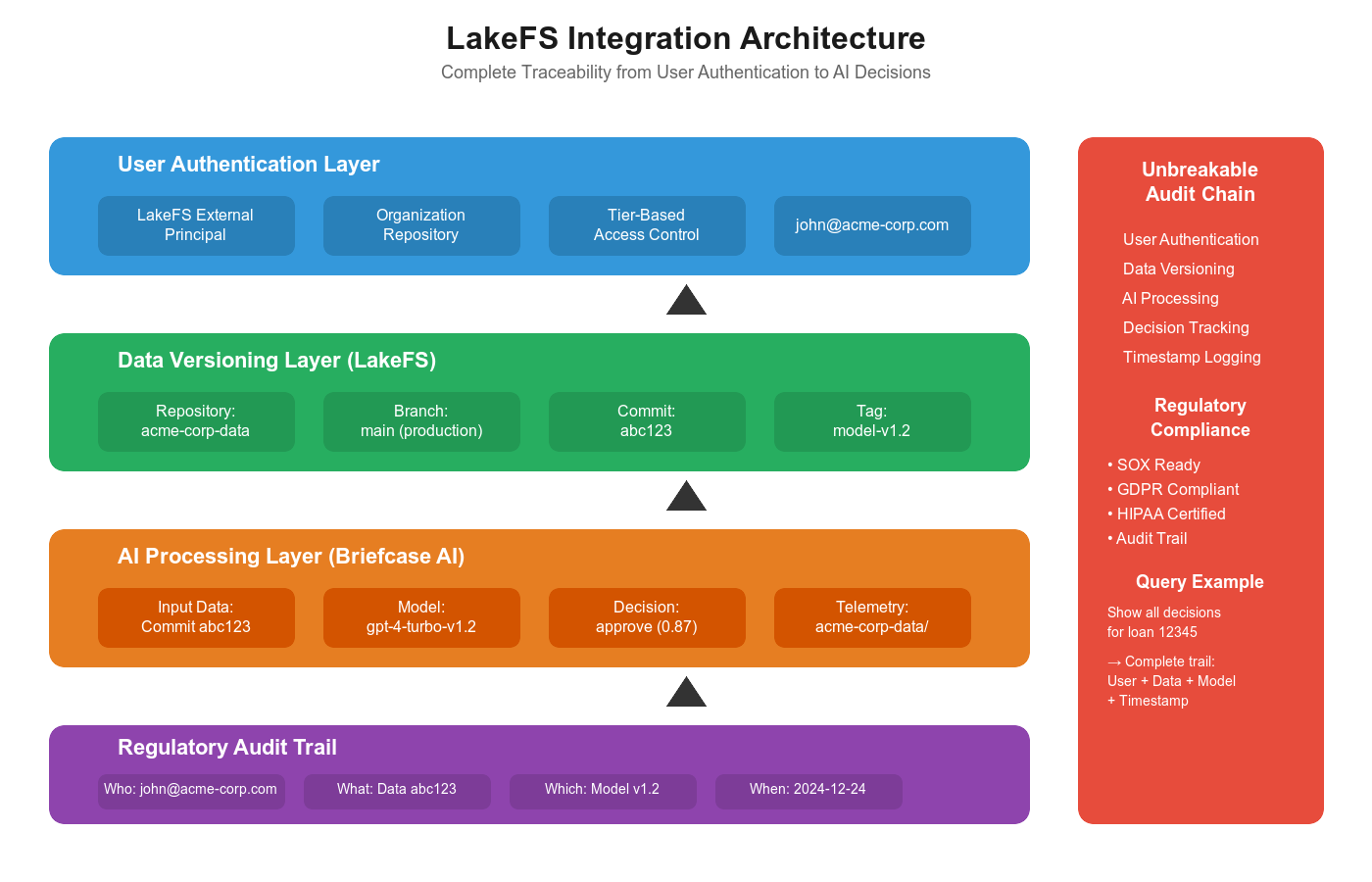 LakeFS Legal Architecture
How Email-Native Contract AI Learns Your Review Rules
We cracked the coordination problem by building AI that works within your existing email workflow. Instead of forcing your team to learn new tools, the AI learns your company's review patterns and applies them automatically to new contracts.
The breakthrough: Email-based AI that learns from your actual review decisions and applies your company's specific rules consistently across all contracts.
How the AI Learns Your Company's Review Rules
1. Email Integration That Actually Works The AI monitors your existing contract review email threads and learns from your team's actual decisions:
- Which clauses your legal team flags as dealbreakers
- What liability limits your company accepts vs. rejects
- How your security team evaluates data handling terms
- Which vendor responses lead to approval vs. walkaway decisions
2. Company-Specific Rule Building Instead of generic contract analysis, the AI builds your company's specific rulebook:
- "Always flag perpetual AI training rights as Tier-1 dealbreakers"
- "Liability caps below $1M trigger automatic escalation"
- "Data deletion terms must specify complete removal within 30 days"
- "Multi-year contracts require CEO approval for terms over 3 years"
3. Progressive Learning from Real Decisions Every contract review teaches the AI more about your company's standards:
- Week 1: AI flags liability cap of $50k as too low based on similar companies' standards
- Week 2: AI learns your team accepted $1M cap, updates rule accordingly
- Week 3: AI automatically flags any future caps below $1M threshold
Email-Native Review Process That Actually Works
How it integrates with your existing workflow:
1. Contract Review Starts in Email When vendor sends contract via email → AI immediately analyzes against your company rules:
- Scans all clauses for known dealbreakers
- Flags high-risk terms based on your team's previous rejections
- Generates preliminary risk assessment within your email thread
- No separate login, no new tool adoption required
2. Smart Escalation Based on Company Rules AI routes contracts automatically based on your learned preferences:
- Low-risk standard agreements: Auto-approve with summary
- Medium-risk contracts: Route to legal team with specific flagged issues
- High-risk dealbreakers: Immediate CEO/exec escalation with detailed analysis
3. Learning From Every Decision Each email decision teaches the AI more about your standards:
- Accept/reject decision → AI records this as company precedent
- Legal team's risk tolerance → AI calibrates future flagging sensitivity
- CEO approval requirements → AI learns escalation thresholds
- Negotiation outcomes → AI suggests similar strategies for future contracts
Complete Audit Trail in Your Email System
Automatic Documentation Without Extra Work:
- Every AI analysis links back to the specific contract sections
- All decisions track which company rules were applied
- Email threads preserve complete decision context for investor diligence
- No separate documentation system needed - everything stays in email
Example: How the AI Documents Decisions When legal team rejects a liability cap:
- "Flagged Terms §11.4: $50k cap below company minimum of $1M"
- "Decision basis: Previous contracts show $1M-$5M standard for Series B companies"
- "Recommendation: Counter with $2M minimum or consider alternative vendor"
- "Approval required: CEO sign-off for caps below $1M per company policy"
Real Contract Review: From 3 Weeks to 2 Days
Here's how the email-native AI transformed an actual vendor contract review that was blocking our enterprise launch.
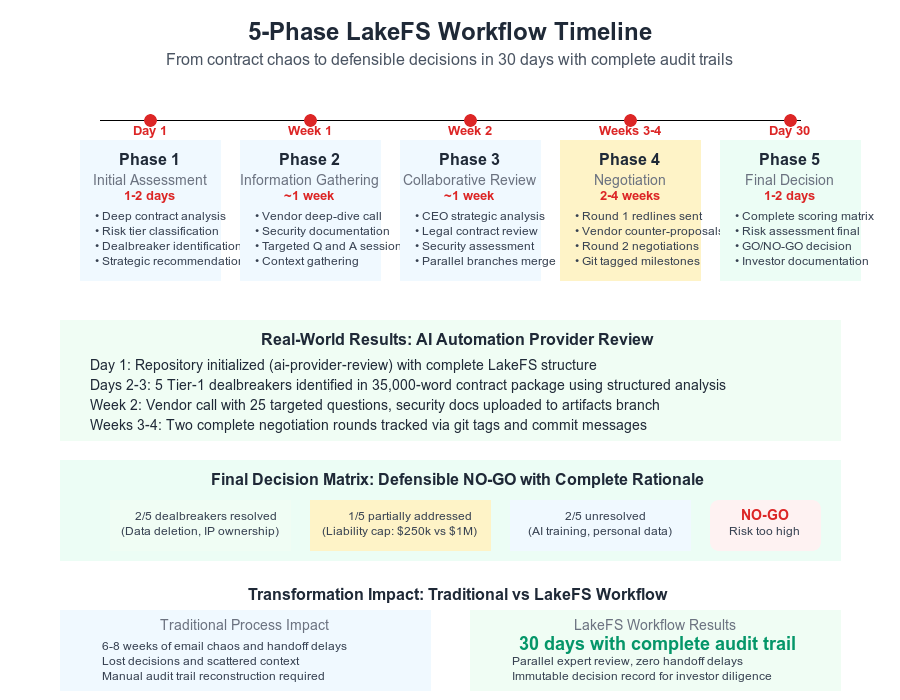 5-Phase Workflow Timeline
Phase 1: Initial Assessment (1-2 days)
Code Example: Initial Assessment Workflow
🔍 Systematic contract analysis with risk classification - Structured approach to identifying dealbreakers early in review process
1# Initial Assessment Template (analysis/initial-review.md)
2
3## Contract Package Analysis
4- **Total word count:** 35,247 words
5- **Documents reviewed:** 4 (Terms, AUP, Privacy, Security)
6- **Review date:** 2024-01-15
7- **Primary reviewer:** CEO + Legal Counsel
8
9## Risk Classification Framework
10
11### Tier 1 - Dealbreakers (🚨)
12Issues that require resolution or partnership termination:
13
141. **Perpetual AI training rights** (Terms §8.2)
15   - Current: "Company grants Vendor unlimited rights to use Customer Data for AI training"
16   - Risk: Customer data used indefinitely without consent
17   - Action: Demand 3-year sunset with deletion rights
18
192. **Blanket personal information ban** (AUP §3.1)
20   - Current: "No personal information may be processed"
21   - Risk: Makes tool unusable with real customer data
22   - Action: Negotiate practical carve-outs for business use
23
243. **Insufficient liability cap** (Terms §11.4)
25   - Current: $50k total liability limit
26   - Risk: Inadequate coverage for potential breach damages
27   - Action: Increase to minimum $1M
28
29### Tier 2 - High Priority (⚠️)
30Significant issues requiring negotiation:
31
324. **Weak data deletion** (Privacy §6)
33   - Current: Vendor retains "improvements" indefinitely
34   - Action: Clarify complete deletion on termination
35
365. **Ambiguous IP ownership** (Terms §9.3)
37   - Current: Unclear rights to customer-generated content
38   - Action: Explicit customer ownership clause
39
40### Initial Recommendation: **NEGOTIATE**
41- 3/5 issues are Tier-1 dealbreakers requiring resolution
42- Partnership viable if key terms addressed in negotiation
This structured analysis provides clear priorities for negotiation and establishes the framework for GO/NO-GO decisions.
The Strategic Insight: Why This Matters for Enterprise Operations
This implementation demonstrates a fundamental truth about scaling legal operations: coordination overhead kills productivity more than document complexity.
Git-style workflows aren't just for software teams. Legal, finance, and business operations all face version control challenges that existing tools don't solve.
Complete audit trails aren't overhead—they're essential for investor diligence, regulatory compliance, and operational excellence.
Parallel review beats sequential handoffs every time when you need to move fast without sacrificing thoroughness.
What This Enables for Enterprise Teams
For Legal Teams: Systematic contract analysis, complete audit trails, and elimination of version chaos For Business Teams: Faster partnership decisions, clear risk assessment, and investor-ready documentation For Engineering Teams: Reduced interrupt load, clear vendor decision criteria, and streamlined integration planning
You can't scale legal operations by adding more reviewers to broken coordination processes. You need systematic workflows that capture context, enable parallel work, and provide complete audit trails.
This is the approach Briefcase AI brings to AI observability: enabling teams to scale complex operations while maintaining the rigor that enterprise environments demand.
Frequently Asked Questions
How does Git-style version control apply to legal documents?
Legal review faces the same coordination challenges that plagued software development before Git: multiple people making changes, lost context about why decisions were made, and inability to track what changed when. LakeFS provides branching, merging, and audit trails for legal artifacts just like Git does for code.
What's the difference between this and traditional contract management systems?
Traditional CLM systems focus on contract storage and basic workflow. This approach provides Git-style version control with complete audit trails, parallel expert review, and systematic risk assessment. It's designed for complex enterprise negotiations where audit integrity matters.
How do you handle the human aspects of contract review?
The technology enables better human coordination by providing isolated workspaces (branches) for each reviewer, complete context about previous decisions, and systematic frameworks for risk assessment. It doesn't replace human judgment—it amplifies it.
Can this work for other enterprise processes beyond contracts?
Yes. Any process involving document review, stakeholder coordination, and audit requirements can benefit from this approach. We've seen teams apply similar patterns to vendor security reviews, compliance assessments, and investment due diligence.
What's the implementation complexity for existing legal teams?
The framework builds on familiar Git concepts that most technical teams already understand. Legal teams learn the workflow structure while technical teams handle the underlying LakeFS infrastructure. Implementation typically takes 2-4 weeks for full adoption.
Related Topics
- Multi-Agent Authentication Migration - Repository-based tenant isolation for AI systems
- AI Observability Crisis - Why systematic measurement matters for enterprise AI
- Browse All Case Studies
Ready to eliminate coordination chaos in your enterprise processes? We're working with legal tech, fintech, and enterprise teams building systematic approaches to complex document workflows. Our version control and observability infrastructure helps teams scale operations while maintaining complete audit trails.
Learn more about systematic enterprise workflows at briefcasebrain.com or contact us at aansh@briefcasebrain.com.
Want fewer escalations? See a live trace.
See Briefcase on your stack
Reduce escalations: Catch issues before they hit production with comprehensive observability
Auditability & replay: Complete trace capture for debugging and compliance